Which chakras go together? Energy compatibility in a couple
In a couple, each chakra goes with the same chakra in your partner: root with root, heart with heart, throat with throat. Together they form seven links. Energy compatibility doesn't depend on one "good" chakra, but on how these seven links flow: relaxed, tense or tilted to one side.
This is what ChakraDuo measures: your chakras, your partner's, and the seven links between you.
No chakra is "incompatible" with another. Two very different people can share a free-flowing heart link, and two people who are alike can clash over communication. Here's how to read these pairings, link by link.
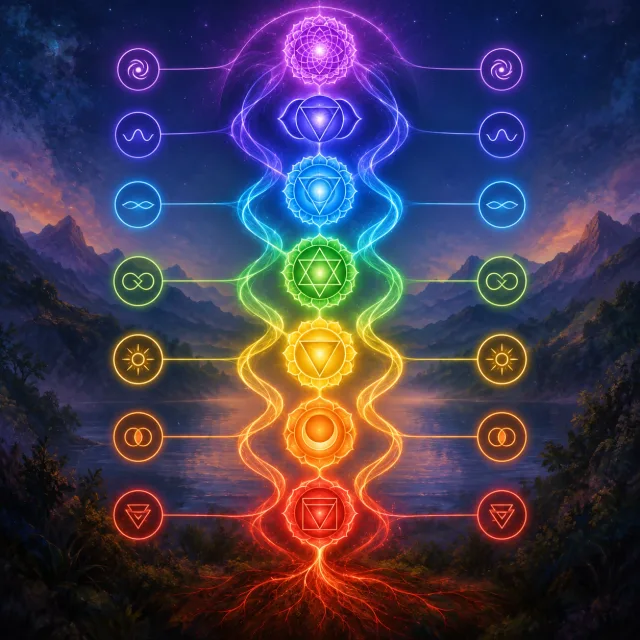
Which chakra pairs with which in a couple?
Each chakra in one partner pairs with the chakra at the same level in the other, because they speak to the same need:
| Chakra | What the link shares | Sign the link is flowing |
|---|---|---|
| Root | Security, money, home | You feel safe together |
| Sacral | Pleasure, tenderness, desire | You laugh, touch, enjoy life |
| Solar plexus | Decisions, each partner's place | You decide together without a power struggle |
| Heart | Love given and received | You give and receive in equal measure |
| Throat | Speaking, listening | You can tell each other anything |
| Third eye | Vision of the future | You see the same direction |
| Crown | Values, meaning | You share what truly matters |
These seven links are explained in our guide chakras for couples. Here, we look at a more specific question: what makes two energies compatible?
What is energy compatibility in a couple?
Energy compatibility is how your chakras get along on each of the seven links: in harmony, in mirror or in a seesaw. You read it link by link, not all at once.
In the ChakraDuo method, each chakra can be underactive (holding back), balanced or overactive (overflowing). Three states for one partner, three for the other: that makes 9 possible combinations on each link, and 63 across the seven links. That's why no two couples are alike.
They fall into three families:
- Harmony: you are both balanced on this chakra. The link is flexible and can weather hard times.
- Mirror: you are both holding back, or both overflowing, on the same chakra. You understand each other very well… including your blocks. Two people who avoid conflict make a peaceful couple, where unspoken things pile up.
- Seesaw: one overflows where the other holds back. The couple compensates, and it can look like harmony. But one partner often carries the load for both. We cover this in false balance in a couple.
So a compatible couple isn't one with seven perfect matches. It's a couple that spots its tense links, where each partner is willing to work on them.
Are there chakras that complement each other between partners?
Yes, and it's often what draws two people together at first. A widespread modern reading pairs the chakras two by two, from one end of the body to the other. We apply it to couples (this is our own reading, not a rule from the tradition):
- Root and crown: feet on the ground, head in the stars. One reassures and organizes, the other brings meaning and momentum. Together, the couple has roots and a horizon.
- Sacral and throat: feeling and saying. One experiences emotions intensely, the other knows how to put them into words. One teaches the other to feel, the other helps them express it.
- Solar plexus and third eye: acting and seeing. One charges ahead and decides, the other steps back and senses what's coming. The couple moves forward without running into a wall.
- The heart, in the middle, connects the two halves. When the heart link flows, these differences become a strength. When it closes, they turn into resentment.
These pairs complement each other as long as each partner values what the other brings. The trap: letting the other carry a whole area ("you handle the money", "you do the talking for both of us") until you no longer know how to do it yourself.
Being alike or complementary: what matters more?
Both matter, but not in the same places: being alike helps with values, being complementary helps with everyday roles.
A large review of 313 studies on attraction (Montoya, Horton and Kirchner, 2008) shows that similarity attracts. In established relationships, what matters most is feeling that you're alike. In daily life, partners tend to complement each other in roles and temperament.
Applied to the chakras, this gives a simple guide:
- On the upper chakras (third eye, crown), being alike helps: close values and a shared vision of the future give you a common direction.
- On the lower and middle chakras (root, sacral, solar plexus), complementing each other can help: one more cautious, the other more daring, for example.
- On the heart and throat, what counts is neither similarity nor difference, but the quality of the connection: talking, listening, showing tenderness.
How can you nurture your couple's energy compatibility?
By spotting your tensest link, rebalancing what one partner carries for both, and taking care of the heart. Compatibility isn't a verdict handed down once and for all: it shifts with fatigue, stress, children and the years. Three simple steps help:
- Spot your tensest link. Each of you picks, among the seven links, the one that feels most fragile right now, then compare.
- Name your seesaws. List together what one of you carries for both (money, planning, difficult conversations). Keep what works for you, rebalance the rest.
- Take care of the heart. Time together each week, screens off. Breathing together for a few minutes with our guided exercise is a good place to start.
For more ideas, read our 7 rituals to harmonize your couple's energy and the 5 love languages.
In summary
- Each chakra goes with the same chakra in your partner: this forms seven links in a couple.
- No chakra is incompatible: we speak of harmony, mirror or seesaw, link by link.
- Some chakras complement each other between partners: root and crown, sacral and throat, solar plexus and third eye, with the heart in the middle.
- Being alike helps with values and the future; being complementary helps with everyday roles.
- Compatibility can be nurtured: it changes with the seasons of life.
Frequently asked questions
Which chakras go together in a couple?
Each chakra goes with the same chakra in your partner: root with root, heart with heart, and so on. This forms seven links, from security to shared meaning.
Are there incompatible chakras?
No. No chakra is incompatible with another. What matters is each partner's state on the same chakra: holding back, balanced or overflowing, and how the couple handles it.
How do we know if our energies are compatible?
Look at your seven links one by one: which ones flow, and which ones bring repeated arguments or fatigue. ChakraDuo's couple test does it for you, with an action plan for each of you and for the couple.
Can two very different people be compatible?
Yes. Differences in temperament can complement each other, especially if you share the same values. They become a problem when one partner always carries the load for both, or when the heart closes.
Can energy compatibility change?
Yes. A chakra reflects a state of the moment, not a fixed trait. Stress, sleep or a new baby can strain a link, and a few regular habits can ease it.
Which of your links flow best, and which are the most tense? Take the couple test: your 21 chakras (each of you, and your couple), the 7 links between you and three action plans.
How does ChakraDuo work? Discover the method.