The origin of chakras: their history, from ancient India to today
The word "chakra" means "wheel" in Sanskrit. The origin of chakras lies in the tantric and yogic traditions of medieval India, which described energy centers along the spine. The seven-chakra system we know today took shape in the 16th century, then spread to the West in the 20th century, along with a few modern additions.
ChakraDuo builds on this modern seven-chakra system, presented here honestly: what comes from the ancient texts, and what was added later.
Knowing this history helps you understand what you practice: what comes from a very old tradition, and what was added more recently. Both have value, as long as you can tell them apart.
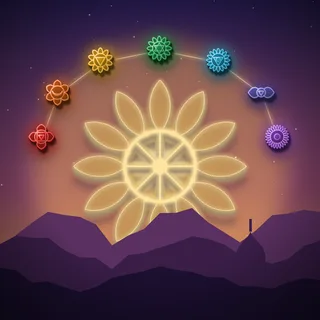
What does "chakra" mean?
In Sanskrit, the classical language of India, cakra (pronounced "chuk-ruh") first means a wheel, such as the wheel of a chariot. By extension, the word suggests a circle, a cycle, something that turns.
In yoga texts, a chakra is an energy center of the subtle body, often shown as a lotus with opening petals. It sits on a central channel that runs along the spine.
Three ideas go with it:
- prana: the life breath, the energy that animates the body;
- nadis: the channels through which prana flows (the texts count tens of thousands of them);
- sushumna: the main, central channel, on which the chakras are placed.
Are chakras Indian?
Yes. Chakras come from India: they were described in Sanskrit texts of the Hindu and Buddhist tantric traditions, mostly between the 8th and 16th centuries. The modern version, with its rainbow colors and its links to psychology, was added in the West in the 20th century.
From the Vedas to the Tantras: a history in 4 stages
| Period | Texts | What they say about chakras |
|---|---|---|
| About 1500 to 500 BCE | The Vedas, India's oldest sacred texts | The cakra is a wheel, a symbol of power and of turning time. Not yet a center in the body. |
| First millennium CE | The Upanishads and early yoga texts | The body is seen as crossed by breaths and channels. The idea of energy points appears. |
| About 8th to 11th century | The Tantras, Hindu and Buddhist | True chakra systems, with visualizations and sounds. Their number varies by school: 4, 5, 6, 9, sometimes more. |
| 1577 | The Ṣaṭ-cakra-nirūpaṇa, by Pūrṇānanda | "The description of the six chakras": the text that set the system behind our 7 chakras. |
So there is no single, eternal chakra system, but a living tradition that evolved over centuries. Tibetan Buddhists, for example, still work today with four or five main centers.
The 7 chakras in the Indian tradition
The 1577 text describes six chakras along the spine, plus a seventh center above the head. That is why its title speaks of "six chakras": the crown is seen as a place apart, the end of the journey.
| Chakra | Sanskrit name | Meaning of the name | Petals | Element | Seed sound |
|---|---|---|---|---|---|
| Root | Muladhara | Root support | 4 | Earth | LAM |
| Sacral | Svadhisthana | One's own abode | 6 | Water | VAM |
| Solar plexus | Manipura | City of jewels | 10 | Fire | RAM |
| Heart | Anahata | The unstruck sound | 12 | Air | YAM |
| Throat | Vishuddha | Very pure | 16 | Ether (space) | HAM |
| Third eye | Ajna | Command, perception | 2 | Mind | OM |
| Crown | Sahasrara | Thousand-petaled | 1,000 | Beyond the elements | Silence |
Each chakra has a lotus, an element, a sound to repeat (the "seed sound", or bija) and, in the texts, a deity and a geometric shape. The elements rise from the densest (earth) to the most subtle (space), then to the mind: the image of an energy that refines itself as it rises.
Kundalini: the energy that awakens from root to crown
In these texts, an energy called kundalini sleeps at the base of the spine, coiled like a serpent (three and a half turns, the texts say). The aim of tantric yoga is to awaken it and help it rise, chakra by chakra, up to the crown.
On either side of the central channel, two other channels wind around it: ida, linked to the moon and to calm, and pingala, linked to the sun and to action. When they are balanced, energy can rise freely.
This image of a gradual awakening, from root to crown, is what you see on the ChakraDuo home page: the couple's chakras light up one by one, from bottom to top.
How chakras reached the West
Chakras traveled to Europe and America in the 20th century, and each step added something:
- 1919, Arthur Avalon: under this pen name, the British judge John Woodroffe published The Serpent Power, the first English translation of the 1577 text. It was the main gateway of chakras into the West (the book is freely available online).
- 1927, Theosophy: Charles Leadbeater published The Chakras. He described the chakras from his own perceptions, and began linking them to the physical body.
- 1932, Carl Jung: the Swiss psychiatrist devoted a seminar to Kundalini yoga. He saw it as a map of personal development. For the first time, chakras also became a matter of psychology.
- 1970s and 1980s: chakras were given the colors of the rainbow, from red (root) to violet (crown), an association often credited to Christopher Hills (1977). Then authors such as Anodea Judith (Wheels of Life, 1987) linked each chakra to life themes: safety, pleasure, confidence, love, expression, intuition, meaning.
Tradition or modern invention? What to remember
The rainbow colors and the link with psychology are modern additions. In the Indian texts, the colors of the lotuses are different, and the chakras serve mainly for meditation and spiritual awakening.
Should we reject them? No. A living tradition evolves, and these additions have made chakras accessible to millions of people. What matters is knowing where each idea comes from:
- what comes from India: the energy centers along the spine, the lotuses, the elements, the seed sounds, kundalini, the breath;
- what comes from the West: the rainbow colors, the link with emotions and life themes, the idea of a "blocked" or "balanced" chakra.
The two complement each other. The Indian tradition brings depth and practices (breathing, postures, sounds). The modern reading brings landmarks to connect these centers to everyday life. To discover the postures linked to each chakra, read our article on yoga poses for the chakras.
The intention behind ChakraDuo
By Stéphane, creator of ChakraDuo.
Yoga has inspired me for more than ten years. When I discovered the history of chakras, one thing struck me: the yogis of ancient India were great observers. They spent centuries observing the breath, the body and the mind, noting what soothes and what stirs, passing on what works.
That is the spirit I wanted to keep. With the analytical mind of a scientist, I set out to make this heritage clear, structured and useful in daily life:
- starting from your real life, with concrete questions about your sleep, your work and your relationships, rather than grand theories;
- telling the nuances apart: a chakra can be underactive, balanced or overactive, and each calls for a different response;
- looking at the couple too, because two people's energies answer and influence each other (see chakras for couples);
- suggesting simple actions, drawn from tradition (breathing, postures, grounding) as well as from modern life, to practice week after week.
ChakraDuo is neither a religion nor a medical diagnosis. It is a tool to know yourself better and, as a couple, to understand each other better. Chakras don't need to be believed in to be useful: they offer a map, and a map helps you see where you are and where you want to go.
To learn more about me and my commitments, read the About page. And to put it into practice, our guide to balancing your chakras is a good place to start.
Frequently asked questions
What country do chakras come from?
From India. The word, the energy centers and the 7-chakra system all come from Indian texts written in Sanskrit. Tibet and Nepal kept close versions in their own traditions.
Are chakras Hindu or Buddhist?
Both. Chakras appear in the Hindu and Buddhist Tantras of medieval India, roughly between the 8th and 11th centuries. The seven-chakra system we know comes from a Hindu text of 1577, but Tibetan Buddhism still works today with its own centers, often four or five.
Why are there seven chakras?
Because the 1577 text that became the basis of the modern system describes six chakras along the spine, plus a center at the top of the head, the crown. That is the model Arthur Avalon translated in 1919, and it became the standard in the West. Other schools count more or fewer.
Are the chakra colors traditional?
No. The rainbow colors, from red for the root to violet for the crown, are a Western association from the 1970s. In the Indian texts, each lotus has its own color, often very different: the heart lotus, for example, is described as red, not green.
What is the oldest text about chakras?
The first detailed descriptions are found in the Tantras, from around the 8th century. The best-known text is later: the Ṣaṭ-cakra-nirūpaṇa, "The Description of the Six Chakras", written by Pūrṇānanda in 1577. You can read it in English in Arthur Avalon's translation, The Serpent Power.
Do you need to be religious to work with your chakras?
No. Chakras come from a spiritual tradition, but you can use them as a map to look at your life from seven angles: safety, emotions, confidence, love, speech, intuition and meaning. That is ChakraDuo's approach: a tool to know yourself better, without dogma.
Where do your chakras stand, and your couple's? Take the couple test: a map of your seven chakras and concrete actions to harmonize your energy.
How does ChakraDuo work? Discover the method.